Home  /  Products  /  SyncHPC AI
SyncHPC AI

Train, deploy & scale AI workloads on GPU clusters

SyncHPC AI orchestrates the full AI lifecycle — from interactive experimentation to scalable, production inferencing — across Kubernetes clusters and vGPU virtual machines.

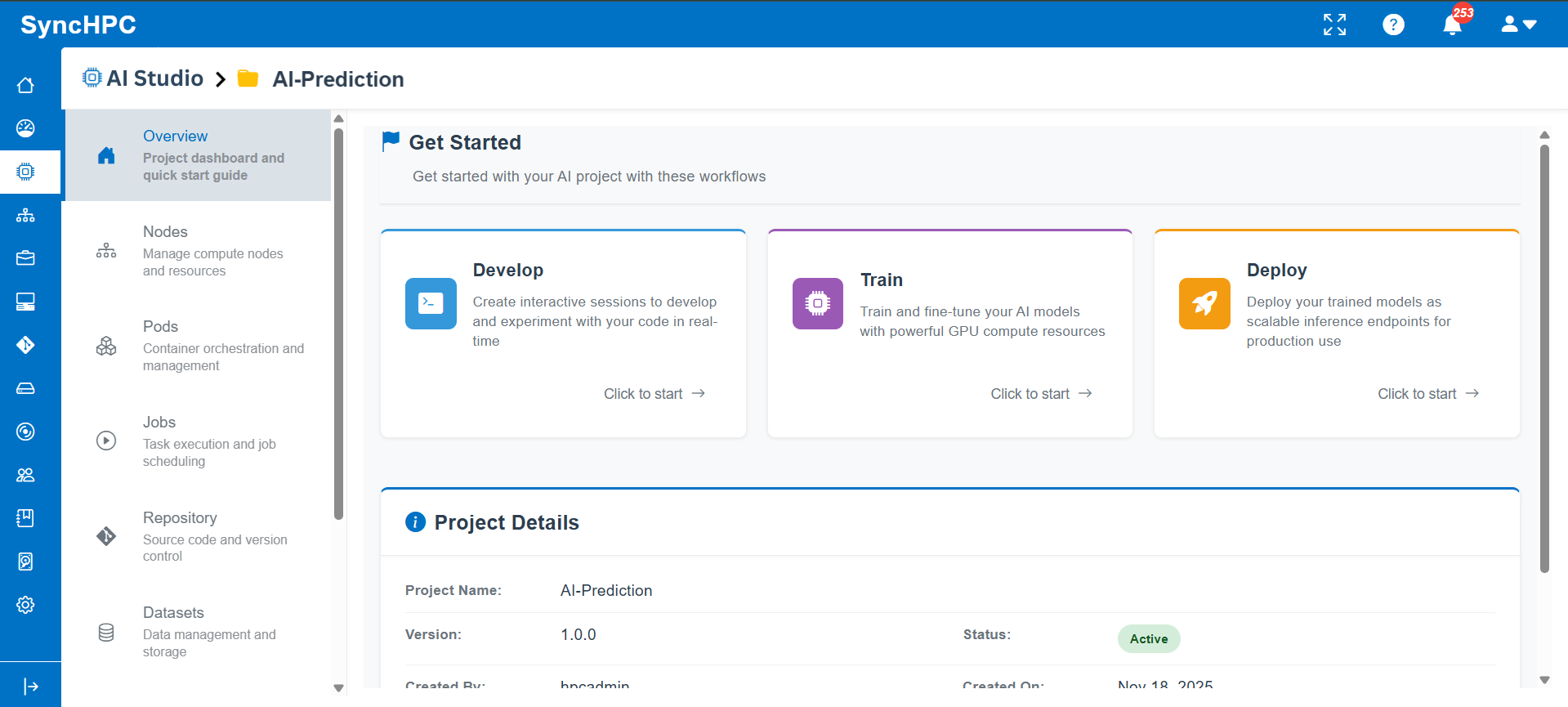
SyncHPC AI interface
Capabilities

Everything your AI teams need, in one platform

Give data scientists self-service access to GPUs while IT keeps governance, security and cost under control.

Model repository & versioning

Centrally store, version and govern models across teams and projects.

Interactive AI workflows

Spin up a Jupyter Notebook or terminal in seconds, backed by GPU compute.

Scalable inferencing

Deploy models for distributed, production-grade inference that scales on demand.

Kubernetes-native

Use kubectl commands and Helm charts to deploy the exact PODs you need.

High-performance GPUs

Run on the latest accelerators, including NVIDIA H100 and H200.

Cost-effective AI labs

Per-user resource allocation and monitoring keep utilization and spend in check.

AI workflows

Two ways to run AI

SyncHPC AI supports both a scalable Kubernetes path and a self-contained vGPU virtual-machine path, so every workload runs where it makes most sense.

Workflow 01 · Kubernetes

AI with Kubernetes (K8S)

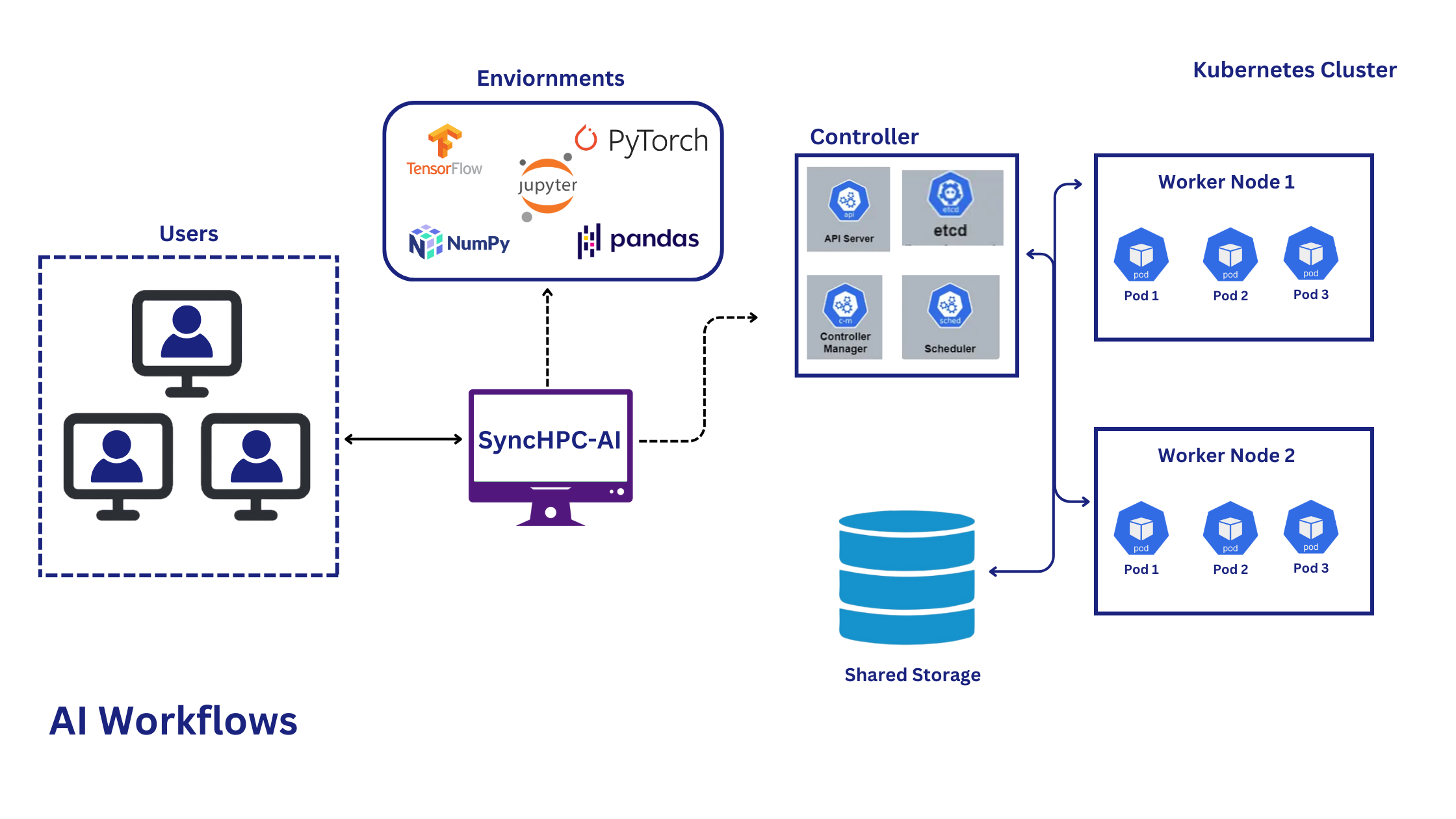
AI with Kubernetes — user workflow diagram
  • 1 Submit your ML/AI problems directly on SyncHPC.
  • 2 Get a Jupyter Notebook or terminal session, instantly.
  • 3 Use kubectl commands and Helm charts to deploy the required PODs.
  • 4 Admins and users monitor resource utilization and per-user workloads.
Pros
  • Maximum flexibility with K8S & user resource management
  • High-performance GPUs like H100/H200 can be used
  • Scalable, with high resource allocation per user
Cons
  • Infrastructure cost will be higher
  • High-performance GPUs (H100/H200) are costly
Workflow 02 · vGPU VMs

AI with vGPU

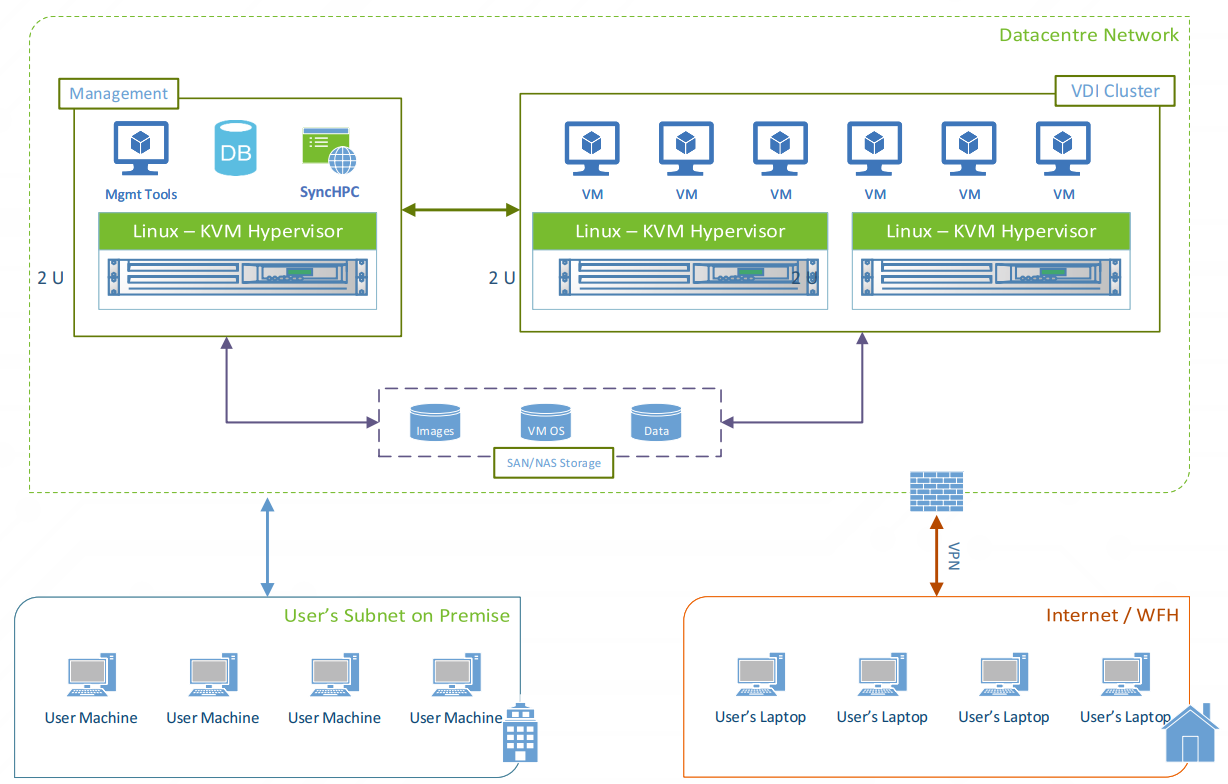
AI with vGPU — virtual machine architecture diagram
  • 1 Connect to a Linux/Windows VM with dedicated CPU, RAM and vGPUs.
  • 2 Use the VM for AI experimentation, analysis and visualization.
  • 3 Run experiments, local ML training, visual graphs and 3D imaging inside the VM.
  • 4 Build and keep your own environment, fully self-contained.
Pros
  • Each user gets their own machine
  • Run medium-size problems at lower cost
  • Build custom environments inside VMs easily
Cons
  • Less scalable than the Kubernetes path
  • Maximum resources per user are limited
Highlights

Ease of Use

Scalable

Replicability

Cost Optimization

Put your GPUs to work

See how SyncHPC AI gives your data scientists self-service compute while IT stays in control of security and cost.